Posts

Showing posts with the label COVID-19

Endemische fase van COVID-19

M.i. gaan we met COVID-19 van een epidemische naar een endemische fase en moeten we ons voorbereiden op een transformatie van ons publieke gezondheidszorgsysteem (coördinatie & capaciteitsmanagement, surveillance, robuuste en tijdige 'health data', NPI's, vaccinatiestrategie, ...).

COVID-19 is here to stay.

  Na de COVID-19 epidemie komt de COVID-19 endemie, een evenwicht tussen ons gedrag, onze (groeps-)immuniteit en de evolutie (mutaties) van het SARS-CoV-2 virus. Na de acute fase van de epidemie komt er ook in toenemende mate de fase van de long covid patiënten, met alle maatschappelijke gevolgen die daaraan vasthangen.

De derde golf in België en COVID-19 variant B.1.1.7

Image
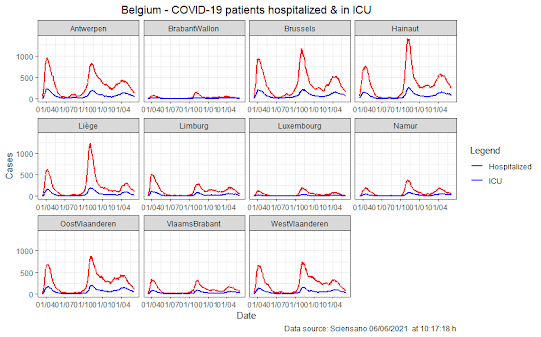
Alhoewel tijdens de derde COVID-19 golf in België minder mensen in het ziekenhuis terechtkwamen, werden er in verhouding meer mensen opgenomen op intensieve zorgen (ICU). Variant B.1.1.7 (WHO Alpha) was de dominante variant tijdens deze derde golf.    

Europa quo vadis in times of COVID-19?

The European Union is remarkably absent as a coordinating and operational force in the current COVID-19 crisis. Why can't Europe coordinate the healthcare emergency caused by COVID-19? The reason for this is hidden deep into the roots of the European Union. We want Europe 'ma non troppo' and then we blame Europe for not being capable to act. Is there a way to create a European public and personal healthcare ecosystem, serving our European patients and our healthcare workers in a time of this COVID-19 crisis and beyond? Not within the limited framework of the Treaty on the Functioning of the European Union (TFEU, aka The Treaty of Rome) and the Treaty on European Union (The Maastricht Treaty). According to Article 168(7) of the 'Treaty on the Functioning of the European Union', Member States are responsible for the definition of their health policy and for the organization and delivery of health services and medical care. The EU can only adopt health legi...

COVID-19: Make it the Last Pandemic?

 As a pandemic such as COVID-19 is a global problem, we will need to act on a global scale in order to prepare for future pandemics, as this will not be the last one we will have to deal with. The consequences of this COVID-19 pandemic will also have an impact for years to come.   From the report of the WHO 'Independent Panel for Pandemic Preparedness and Response': "The COVID-19 pandemic is a sign of how vulnerable  and fragile our world is. The virus has upended societies, put the world’s population in grave danger and exposed deep inequalities. Division and inequality between and within countries have been exacerbated, and the impact has been severe on people who are already marginalized and disadvantaged. In less than a year and a half, COVID-19 has infected at least 150 million people  and killed more than three million. It is the worst  combined health and socioeconomic crisis in living memory, and a catastrophe at every level."  The Independent ...
COVID-19 varianten in België

Image
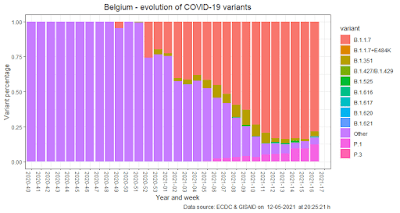
  De evolutie van COVID-19 varianten in België tot begin mei 2021, waaronder B.1.1.7 (20I/501Y.V1), B.1.351 (20H/501Y.V2), P.1 (20J/501Y.V3) en B.1.167 (Data van ECDC & GISAID:  https://www.ecdc.europa.eu/en/publications-data/data-virus-variants-covid-19-eueea ). Meer besmettelijke varianten, zoals o.a. B.1.1.7, verhogen de exponentiële verspreiding van het virus, wat zorgt voor een snellere overbelasting van de gezondheidszorg. Wat B.1.167 ons gaat brengen is nog enigszins af te wachten ( https://twitter.com/AdamJKucharski/status/1343567425107881986 ).